Why Roulette Divides Its Layout into Inside and Outside Bets
Roulette inside and outside bets become easier to distinguish when you read the layout by position and outcome type, not as clues to what comes next.
The most common mistake with roulette inside and outside bets is to treat their positions on the table as hints about what the wheel will do. That confusion can turn a simple layout into a supposed pattern-reading tool, when the distinction is really about how a wager is placed and which results it covers.
Imagine you are looking at a European roulette layout for the first time. A friend has placed a chip on one numbered square and another across a broad box labeled “red.” The first wager is inside; the second is outside. Their locations explain the names, while the marked outcomes explain what each choice means.
The table separates number choices from broader groups
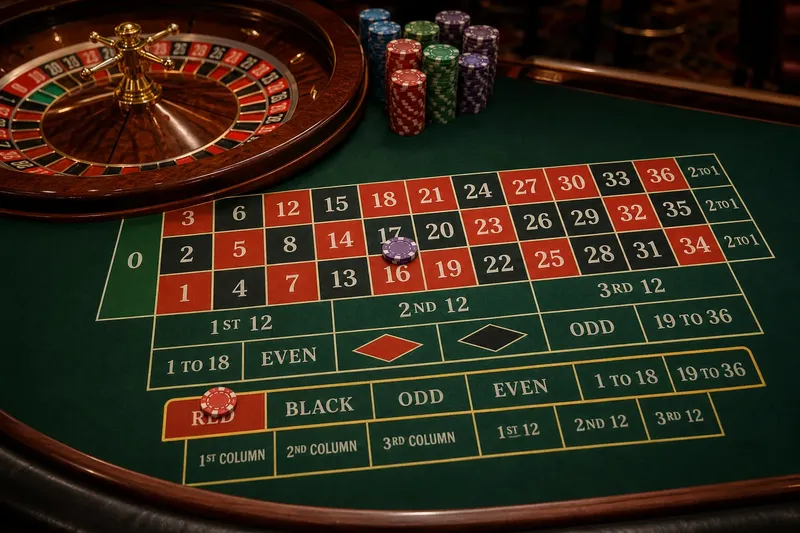
On a standard roulette layout, the numbered grid holds the numbers from 1 through 36, arranged in rows and columns. A separate set of spaces sits around the grid for categories such as red or black, odd or even, and low or high numbers. The green zero space appears apart from those red-and-black groups.
“Inside” and “outside” describe regions of the betting layout, not places on the wheel. Inside bets are made on the numbered grid or its boundaries. Outside bets are placed in the designated areas around that grid and usually cover groups of numbers rather than a single number.
The layout lets a player see two kinds of decision at a glance: choose a particular number or small combination, or choose a broader category. It does not give either region a predictive role. The ball’s next resting place is not indicated by where a previous chip landed.
Inside bets mark particular numbers or compact combinations
A straight-up bet sits on one number. A split bet straddles the line between two neighboring numbers; a street covers a row of three; and a corner covers four numbers where the grid’s corners meet. A six-line bet spans the boundary shared by two adjacent rows, covering six numbers.
These placements are read from the printed grid. The chip’s exact location matters because it identifies the number or group selected. On a busy table, the dealer may help clarify an ambiguous placement, but the underlying idea remains visual: a chip on a number or its shared border marks a narrower selection.
Inside does not mean “more skillful,” “more likely,” or “closer to the action.” It describes the selection’s position and scope. A single-number choice is narrower than a six-number choice, but neither placement reveals where the next ball will land.
Outside bets name broad categories around the grid
Outside areas commonly include red and black, odd and even, low and high, and columns or dozens. A red wager selects the red numbers; an odd wager selects the odd-numbered group; a column or dozen selects a larger set identified by its position or range on the layout.
These boxes are easy to spot because they sit outside the numbered grid and carry category labels. Their breadth makes them different from a straight-up number bet, not more informative about the wheel. The zero is a useful reminder: it does not belong to red or black, odd or even, or low or high, so those categories are not simply every number on the layout divided without exception.
Names and exact layout details can vary by roulette format and table. Check the printed layout and posted rules for the game in front of you; they determine which spaces and conventions apply.
A hypothetical table visit shows how the distinction works
Say you sit at a European roulette table with a clear grid, one green zero, and the usual labeled outside boxes. You decide to place a chip on the number 17, then put a second chip in the red box. The first chip marks one numbered outcome; the second marks the red category.
As the dealer calls for bets to close, you notice that the chip on 17 is inside the grid while the red wager is outside it. The distinction is visible before the wheel spins. It comes from placement and the outcomes named by each area, not from a reading of earlier spins.
Imagine the ball then lands on black 8. The red wager does not match the result, and the 17 wager does not match it either. That outcome shows how each selection is judged against the result; it does not tell you that a red result is now due, or that 17 has become more or less likely on the next spin.
The useful lesson from this invented situation is modest: read the chip’s location to identify the wager, then read the result against the selected number or category. The layout organizes choices; it does not forecast them.
Why does the layout use inside and outside labels?
What counts as an inside bet?
An inside bet is placed on a number or on a boundary that identifies a compact group within the numbered grid. Straight-up, split, street, corner, and six-line bets are familiar examples.
What counts as an outside bet?
An outside bet is placed in a labeled area beyond the numbered grid, often selecting a color, parity group, range, column, or dozen. The exact available choices depend on the roulette layout.
Does an inside bet predict a less likely result?
No. “Inside” describes where the wager is placed and the scope of its selection, not a forecast. Roulette outcomes are determined by the spin, and the layout supplies no signal about which result is next.
Why is zero excluded from many outside groups?
Zero is a separate green space and is not part of the red-or-black, odd-or-even, or low-or-high groups. That exception is printed into the game’s structure, so a player should read the table markings rather than assume the categories cover every number.
Read the layout without turning it into a pattern chart
When you approach a roulette table, first locate the numbered grid, the zero, and the labeled categories around the grid. Then identify whether a chip rests on a number or boundary, or inside one of the surrounding boxes. This is enough to understand the inside-and-outside distinction without memorizing a theory about “hot” areas.
It is not worth the effort to track a run of colors or numbers as though the table were leaving clues. For a player trying to understand roulette inside and outside bets, the more useful habit is to match each wager to its printed space and treat each spin as a separate result. The layout is a map of available choices, not a map of what comes next.